
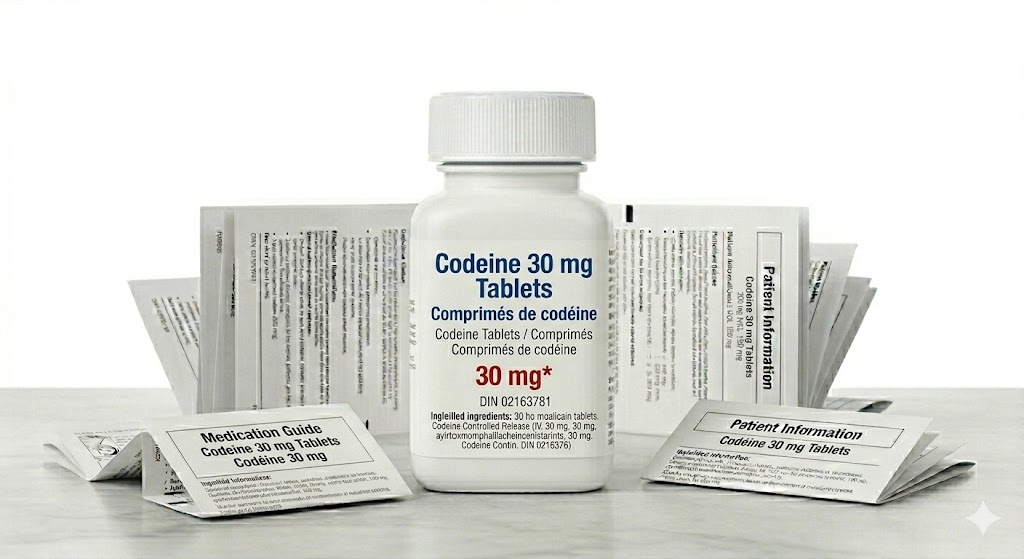
Complete Guide to Codeine 30 mg Tablets in Canada
Disclaimer: This information is for education only. It is not medical advice. Always talk to a Canadian doctor or pharmacist first. Codeine 30 mg tablets contains controlled narcotics. A doctor must prescribe and monitor it.
Codeine 30 mg tablets contain 30 mg of codeine phosphate in immediate-release form. This product is available in Canada for adults. Doctors use it for the relief of mild to moderate pain. The dose must be individualized.
This guide covers uses, how the drug works, dosing, side effects, interactions, warnings, and Canadian details. You can use it to prepare for talks with your healthcare team. In addition, it aims to give clear and practical information for Canadian patients.
WHAT IS CODEINE USED FOR?
Health Canada approves codeine for the relief of mild to moderate pain. Doctors choose it when non-opioid options fail or are not enough. It is generally used on a regular or as-needed schedule under close supervision.
Furthermore, doctors do not use it for severe pain alone. Codeine carries risks of addiction and overdose. Therefore, doctors reserve this drug for carefully selected patients only.
Moreover, the 30 mg strength is a higher dose often used after careful titration. Health Canada restricts use in children and adolescents for certain conditions. As a result, careful patient selection remains essential in Canadian practice.
HOW DOES CODEINE WORK?
Codeine is a weak opioid agonist at the mu-opioid receptor. The body converts some codeine into morphine. These actions reduce the perception of pain and the emotional response to it.
In addition, the immediate-release tablet starts working within 30 to 60 minutes. Peak effects usually occur within one to two hours. Effects last about four to six hours. Consequently, it is used for mild to moderate pain.
Furthermore, the liver converts codeine to morphine via the CYP2D6 enzyme. Genetic differences change how people respond. Some patients need lower doses. Others get little benefit. Therefore, your doctor considers these factors when setting your dose.
CODEINE SIDE EFFECTS
Common side effects include drowsiness, nausea, vomiting, constipation, dizziness, dry mouth, and itching. These often appear at the start or after a dose increase. However, many patients notice them less over time.
Serious side effects can occur. These include slow or stopped breathing, severe sedation, low blood pressure, confusion, dependence, and hormonal changes. Many effects link to dose size. They may ease with time or dose change. In addition, constipation almost always needs ongoing care with fluids, fibre, and laxatives.
Moreover, report any severe or lasting symptoms to your doctor right away. Regular visits help track both benefits and problems. As a result, early reporting allows safer adjustments.
CODEINE DOSAGE
A doctor must set the dose for each person. For adults, typical doses start low and increase carefully. The 30 mg tablet is a higher strength often used after careful titration.
Furthermore, older adults or people with liver, kidney, or breathing problems often need much lower doses. Doctors always aim for the lowest effective dose. Therefore, never change your dose without medical advice.
In addition, swallow each tablet whole with water. Take it exactly as directed, either on a schedule or as needed for pain. Never crush, chew, or dissolve the tablet unless directed. Consequently, exact timing helps maintain pain control and reduces risks.
HOW TO TAKE CODEINE
Take the tablet exactly as your doctor directs. Swallow it whole with a full glass of water. You may take it with or without food. However, food can reduce stomach upset for some people.
Moreover, store tablets at room temperature between 15 °C and 30 °C. Keep them dry and away from light. Lock them away from children and others. Never share this drug. Sharing controlled drugs is illegal and unsafe.
In addition, ask your pharmacist if any instruction is unclear. Do this before you change anything. As a result, proper use lowers the chance of side effects and overdose.
CODEINE INTERACTIONS
Codeine interacts with many drugs. Central nervous system depressants create the highest risk. These include alcohol, benzodiazepines, other opioids, sedatives, and muscle relaxants. The mix can cause deep sedation, slow breathing, coma, or death.
Furthermore, drugs that affect the CYP2D6 enzyme change codeine activation. Some antidepressants and antipsychotics also raise risks. Therefore, give your doctor and pharmacist a full list of everything you take. Full disclosure helps prevent harmful interactions.
CODEINE WARNINGS
Codeine carries risk of addiction, abuse, and misuse. Life-threatening slow breathing can start when treatment begins or the dose rises. Accidental overdose can be fatal, especially in children.
In addition, doctors use the 30 mg strength with extra caution. Older adults and people with liver, kidney, or breathing problems need extra care. Sudden stops after regular use can trigger withdrawal. Never mix the drug with alcohol. Moreover, your doctor should review the need for continued treatment regularly. As a result, ongoing monitoring supports safer use.
CODEINE ALTERNATIVES
Non-opioid options and multimodal care may help some patients. Other weak opioids or different pain medications may also work under close supervision. Physical therapy, interventional procedures, and psychological support often improve outcomes.
Furthermore, Canadian guidelines favour non-opioid and team-based approaches for chronic pain whenever possible. The best choice depends on pain type, past treatments, personal risks, and patient goals. Therefore, discuss all options openly with your doctor.
CODEINE VS. OTHER OPIOIDS
Codeine is a weaker opioid than morphine or hydromorphone. It provides relief for mild to moderate pain. However, it still carries risks of respiratory depression and dependence.
Moreover, immediate-release codeine suits short-term or intermittent mild-to-moderate pain. Stronger opioids suit more severe pain. It is not ideal for severe continuous pain. Consequently, your doctor can help compare options based on your needs.
IS CODEINE SAFE DURING PREGNANCY?
Doctors use codeine in pregnancy only when the benefit clearly outweighs the risk. Prolonged use can cause neonatal opioid withdrawal syndrome. Data show clear risks to the newborn. Women who are pregnant or plan pregnancy should review all options with their doctor. Furthermore, non-opioid methods are often preferred when they provide enough relief. As a result, open discussion supports safer choices.
CAN I DRINK ALCOHOL WHILE TAKING CODEINE?
No. Avoid all alcohol while you take codeine. Alcohol plus codeine raises the chance of sedation, slow breathing, overdose, and death. Canadian labels and guidelines warn strongly against this mix. In addition, tell your doctor if you find it hard to avoid alcohol so safer choices can be discussed. Therefore, complete avoidance is the safest approach.
HOW LONG DOES CODEINE TAKE TO WORK?
The immediate-release form usually starts to relieve pain within 30 to 60 minutes. Peak effects often occur within one to two hours. Effects last about four to six hours. Response still varies by dose, metabolism, and health. Consequently, take it as directed for best results.
WHAT HAPPENS IF I MISS A DOSE OF CODEINE?
Take the missed dose as soon as you remember if it is not close to the next one. Skip it if the next dose is near. Never take two doses together or extra tablets. Extra amounts can push levels too high and cause harm. In addition, contact your doctor or pharmacist if you miss doses often or have questions.
FREQUENTLY ASKED QUESTIONS ABOUT CODEINE
How long can I take codeine? Use the lowest dose that works for the shortest time needed. Long-term use needs regular doctor review because of dependence and other risks. Furthermore, your doctor will guide any changes.
Can I drive while taking codeine? The drug can cause drowsiness and slower reactions. Do not drive until you know how it affects you, especially at the start or after a dose rise. Therefore, safety comes first.
Is codeine addictive? Yes. Codeine creates physical dependence and carries abuse potential. Take it only as prescribed and discuss any concerns with your doctor. In addition, early talk helps manage risks.
Does codeine show up on drug tests? Yes. Standard screens usually detect codeine or related opioids. Tell testing staff about your prescription if needed.
What should I do in case of overdose? Call 911 at once. Give naloxone if you have it and know how. Stay with the person until help arrives. Watch for extreme sleepiness, very slow breathing, or loss of consciousness.
Can I crush or split the tablet? Check with your pharmacist. Never crush or chew unless directed. Therefore, follow exact instructions.
STORAGE AND DISPOSAL IN CANADA
Keep tablets at room temperature between 15 °C and 30 °C. Protect them from moisture and light. Store them in a locked place away from children and others. Return unused or expired tablets to a pharmacy for safe disposal. Do not flush them or put them in household trash. In addition, proper disposal protects others and the environment.
DEPENDENCE, TOLERANCE AND WITHDRAWAL
Regular use of codeine creates physical dependence. Sudden stops may cause anxiety, sweating, insomnia, aches, nausea, vomiting, and other symptoms. Any plan to stop after regular use needs doctor supervision. Furthermore, a slow taper usually reduces withdrawal discomfort. As a result, support from your healthcare team improves the process.
CANADIAN PRESCRIBING GUIDELINES AND ACCESS
Codeine is a controlled substance in Canada. Doctors follow national and provincial opioid guidelines. These stress careful patient choice, clear consent, ongoing checks, and steps to lower misuse risk. You can obtain Codeine 30 mg tablets only with a prescription from a Canadian pharmacy. Moreover, access rules help keep patients safer.
COST AND INSURANCE COVERAGE IN CANADA
Coverage differs by province and private plan. Some plans list codeine products as a general benefit. Ask your pharmacist or insurer for current details and any co-payment amounts. Therefore, understanding coverage helps avoid unexpected costs.
WHEN TO SEEK EMERGENCY HELP
Get help at once for slow breathing, extreme drowsiness, seizures, severe allergy, overdose signs, or thoughts of self-harm. Call 911 right away. Keep naloxone on hand if overdose risk exists in your home and make sure others know how to use it. In addition, quick action can save lives.
BUY CODEINE 30 MG TABLETS ONLINE IN CANADA
Codeine 30 mg Tablets contain codeine phosphate, an opioid analgesic and antitussive used in Canada for the symptomatic treatment of mild to moderate pain of various causes and for the control of exhausting, non-productive cough that does not respond to non-opioid antitussives. This guide explains how to get Codeine 30 mg Tablets in Canada through legal channels only. It covers prescriptions, pharmacies, coverage, safety, practical steps, and important considerations for patients. All information is general and educational. Therefore, it does not replace advice from a licensed Canadian healthcare provider.
Always speak with a doctor, nurse practitioner, or pharmacist before starting or changing any treatment. Moreover, single-entity codeine (such as Codeine 30 mg Tablets) is a controlled substance (Narcotic under the Controlled Drugs and Substances Act, Schedule I) in Canada. Consequently, it requires a valid prescription. Unlike low-dose codeine combination products (containing up to 8 mg codeine with two or more non-narcotic ingredients), pure codeine 30 mg tablets are not available without a prescription.
HOW TO BUY CODEINE 30 MG TABLETS ONLINE IN CANADA
Getting Codeine 30 mg Tablets in Canada starts with a thorough medical assessment. First, you must see a licensed healthcare provider who can evaluate your pain or cough and decide if this medication is appropriate.
The process usually includes a detailed clinical evaluation of your symptoms, previous treatments, current medications, and overall health. Once the assessment is complete, the provider may decide that codeine is suitable for mild to moderate pain or non-productive cough. Afterward, you receive a prescription and take it to a licensed pharmacy.
Codeine 30 mg Tablets are available only by prescription. Therefore, there is no legal over-the-counter option for this single-entity product. Furthermore, online sources without a Canadian prescription are not legal and may be unsafe. Patients should avoid any offers that claim to supply the medication without proper medical oversight.
Codeine has long been regulated as a narcotic. As a result, prescriptions for straight codeine products follow narcotic rules (written or, under certain temporary exemptions, verbal in some cases), with restricted refills. This framework was designed to improve safety and reduce the risk of misuse while still protecting access for patients who need the medication.
WHERE TO BUY CODEINE 30 MG TABLETS ONLINE IN CANADA
You can obtain Codeine 30 mg Tablets at licensed community pharmacies across Canada once you have a valid prescription. In addition, most pharmacies that dispense controlled substances can order or stock this product.
Start by finding a prescriber such as a family physician, specialist, or authorized nurse practitioner. After receiving the prescription, take it to a pharmacy. Meanwhile, call ahead to confirm current stock of the 30 mg strength. Many larger pharmacy chains and independent pharmacies that handle narcotics can obtain Codeine 30 mg Tablets (for example, Teva-Codeine).
Hospital outpatient pharmacies may also dispense it under medical supervision. Consequently, patients have several practical options depending on their location and care setting.
CAN I BUY CODEINE 30 MG TABLETS ONLINE IN CANADA?
Yes, you can get Codeine 30 mg Tablets in Canada if a licensed prescriber determines they are medically appropriate for you. Products such as Teva-Codeine 30 mg Tablets (DIN 00593451) are marketed and regulated by Health Canada.
It is indicated for the symptomatic treatment of mild to moderate pain and for the control of exhausting, non-productive cough that does not respond to non-opioid antitussives. It is generally used on an as-needed basis rather than around-the-clock. Eligibility depends on clinical assessment, not simply on request. In addition, codeine is not recommended in children under 12 years of age in most cases due to safety concerns related to variable metabolism.
Provincial rules and individual clinic policies influence prescribing practices. Therefore, access can differ slightly from one region to another. Most adults who meet the clinical criteria can receive a prescription after proper evaluation.
HOW DO I GET A PRESCRIPTION FOR CODEINE 30 MG TABLETS?
To get a prescription for Codeine 30 mg Tablets, book an appointment with a qualified Canadian healthcare provider. First, bring your health card and be prepared to discuss your pain or cough history, previous treatments, medical conditions, and current medications in detail.
The provider will assess whether codeine is suitable. Moreover, they will review risks, benefits, and non-opioid alternatives. Treatment is usually started at the lowest effective dose for the shortest appropriate duration. The 30 mg strength is commonly used within the usual adult dosing range.
If appropriate, the provider issues a prescription that meets narcotic documentation requirements. In addition, telehealth options exist in some provinces for assessment and ongoing care, subject to controlled-substance rules. Patients should confirm whether their province allows virtual prescribing of narcotics.
BUY CODEINE 30 MG TABLETS WITHOUT A PRESCRIPTION IN CANADA
Getting prescribed Codeine 30 mg Tablets in Canada involves informed consent and a clear treatment plan. Therefore, the prescriber explains how the medication works, possible side effects, and the importance of taking it exactly as directed.
Treatment is individualized. Consequently, the lowest effective dose for the shortest appropriate duration is preferred, with regular reassessment when needed. In addition, many clinicians discuss risks of dependence and provide guidance on safe use.
Because single-entity codeine is a narcotic, prescriptions follow federal and provincial rules. As a result, automatic long-term refills are generally not permitted without reassessment. This requirement helps ensure ongoing safety and appropriateness of treatment.
CODEINE 30 MG TABLETS PRESCRIPTION REQUIREMENTS IN CANADA
Prescription requirements for Codeine 30 mg Tablets follow federal narcotic regulations and provincial professional standards. First, the prescription must come from an authorized practitioner.
It typically includes the patient’s name, the exact product and strength, quantity, directions, and the prescriber’s details. Verbal prescriptions may be permitted under certain temporary exemptions, but written prescriptions are standard for narcotics. Furthermore, refills are restricted, and a new prescription is usually required for continuation.
Pharmacists must verify the prescription carefully. Meanwhile, they may contact the prescriber if anything is unclear. Transfers between pharmacies follow narcotic rules as well. Patients should keep a record of their prescriptions for continuity of care.
WHO CAN PRESCRIBE CODEINE 30 MG TABLETS IN CANADA?
Physicians and, in most provinces, nurse practitioners can prescribe Codeine 30 mg Tablets. However, they must have the knowledge, skill, and judgment to prescribe opioids safely and appropriately.
Family physicians, specialists, and other authorized practitioners commonly prescribe this medication when indicated for mild to moderate pain or non-productive cough. Therefore, always confirm that the provider is licensed in your province and authorized to prescribe controlled substances. Some provinces maintain additional monitoring programs for opioid prescriptions.
HOW TO ACCESS CODEINE 30 MG TABLETS LEGALLY IN CANADA
Legal access to Codeine 30 mg Tablets in Canada requires a valid prescription from a Canadian-authorized prescriber and dispensing by a licensed Canadian pharmacy. Consequently, this is the only lawful route.
Avoid any website, social media offer, or individual claiming to supply the medication without a prescription. In addition, such sources are illegal and potentially dangerous. Patients should report suspicious offers to the appropriate authorities.
If you are already taking codeine, your new provider can arrange continuity of care. Moreover, a new prescription can be issued if appropriate after reassessment.
HOW TO OBTAIN CODEINE 30 MG TABLETS WITH A VALID PRESCRIPTION
Once you have a valid prescription for Codeine 30 mg Tablets, present it at a pharmacy along with identification and your provincial health card. Afterward, the pharmacist will review the prescription and prepare the medication.
Take the tablet as directed, usually every 4 to 6 hours as needed for pain (or every 6 to 8 hours for cough, not exceeding recommended daily limits). Therefore, swallow the tablet whole with water. Do not crush, chew, or dissolve tablets unless specifically instructed by your pharmacist or prescriber.
Keep the medication secure at all times. Furthermore, report lost or stolen tablets to both the pharmacy and the prescriber immediately. Proper storage helps prevent accidental ingestion or diversion.
WHERE CAN I FILL A CODEINE 30 MG TABLETS PRESCRIPTION IN CANADA?
You can fill a Codeine 30 mg Tablets prescription at most community pharmacies that handle narcotics. In addition, independent pharmacies, large chains, and some hospital outpatient pharmacies all dispense it when stocked or ordered.
Call ahead to confirm availability of the 30 mg strength. Meanwhile, if one pharmacy is out of stock, another nearby location or an order usually resolves the issue within a short time.
HOW TO REFILL A CODEINE 30 MG TABLETS PRESCRIPTION
Refills for Codeine 30 mg Tablets are restricted because single-entity codeine is a narcotic. Therefore, many prescriptions require a new authorization from the prescriber for continuation.
Contact your clinic or doctor before the current supply runs out if further treatment is needed. In addition, regular follow-up may be required. Pharmacists cannot automatically refill narcotic prescriptions indefinitely. Planning ahead prevents gaps in treatment.
CAN A PHARMACIST DISPENSE CODEINE 30 MG TABLETS?
Yes, licensed pharmacists in Canada can dispense Codeine 30 mg Tablets when presented with a valid prescription from an authorized practitioner. Moreover, they verify the prescription, counsel patients on proper use, and monitor for safety concerns.
Pharmacists play an important role in educating patients about opioid risks and safe use. Consequently, they cannot independently prescribe the medication in most situations (except in limited cases for certain exempted low-dose products, which do not apply to 30 mg single-entity tablets). Patients should take advantage of the counselling offered at the pharmacy.
BUY CODEINE 30 MG TABLETS NEAR ME IN CANADA
Yes, Codeine 30 mg Tablets are available in Canada. Health Canada has authorized products such as Teva-Codeine 30 mg Tablets (DIN 00593451), and they are marketed by manufacturers including Teva Canada Limited.
Supply of standard formulations is generally maintained through the regular pharmaceutical chain. However, temporary shortages of specific products can occur from time to time. Therefore, confirm current availability with your pharmacy.
IS CODEINE 30 MG TABLETS COVERED BY PROVINCIAL DRUG PLANS?
Coverage for Codeine 30 mg Tablets varies by province and territory. In many public drug plans it is listed as a general benefit or regular benefit (for example, on the Ontario Drug Benefit formulary for Teva-Codeine).
Private insurance plans frequently cover codeine products, subject to plan rules. In addition, check your specific plan or ask the pharmacist and prescriber about coverage and any requirements. The Non-Insured Health Benefits program may also have relevant listings for eligible clients. Patients should ask about potential out-of-pocket costs early in the process.
CODEINE 30 MG TABLETS AVAILABILITY IN CANADA
Availability of Codeine 30 mg Tablets in Canada is maintained through the regular pharmaceutical supply chain. Moreover, most pharmacies that dispense controlled substances can obtain it promptly when ordered.
If one pharmacy is out of stock, another location or an order usually resolves the issue quickly. Patients can ask their pharmacist about currently available brands or strengths if needed.
CODEINE 30 MG TABLETS PATIENT INFORMATION CANADA
Patient information for Codeine 30 mg Tablets is provided in the official product monograph and patient medication information leaflet available from Health Canada and the manufacturer. Therefore, these documents explain proper use, storage, and important warnings in detail.
Take the tablet exactly as prescribed. In addition, store the medication securely out of reach of children and others. Meanwhile, never share your tablets with anyone else.
Keep the original packaging when travelling within Canada. Patients should also review the leaflet each time they receive a new supply in case of updates.
HOW TO TALK TO YOUR HEALTHCARE PROVIDER ABOUT CODEINE 30 MG TABLETS
Prepare for the conversation by writing down your questions and concerns. First, be honest about your pain or cough, previous treatments, and goals. Then ask about expected benefits, possible side effects, and non-opioid alternatives.
Discuss any other medications or health conditions you have, especially respiratory issues, liver or kidney problems, or history of substance use. Moreover, ask how monitoring will work and what to do if symptoms are not controlled or side effects occur. Bring a list of all current medications to the appointment.
A good provider will explain options clearly. Consequently, you can take part in shared decision-making and feel more confident about the treatment plan.
WHEN IS CODEINE 30 MG TABLETS PRESCRIBED?
Codeine 30 mg Tablets are prescribed when a healthcare provider determines that mild to moderate pain or non-productive cough requires an opioid after non-opioid options have been considered or are insufficient.
Prescribers consider the type and duration of symptoms, previous treatments, risk of dependence or adverse effects, and the patient’s overall health. Therefore, it is not indicated for mild pain that can be managed with non-opioid medications, or as a first-line option in most cases. Use in children under 12 is generally not recommended. The 30 mg strength is commonly used within the usual adult dosing range.
WHAT CONDITIONS IS CODEINE 30 MG TABLETS PRESCRIBED FOR?
The primary approved uses of Codeine 30 mg Tablets in Canada are the symptomatic treatment of mild to moderate pain of various causes and the control of exhausting, non-productive cough that does not respond to non-opioid antitussives.
Providers follow clinical guidelines that emphasize non-opioid approaches first whenever possible. Patients should discuss the full range of pain or cough management options with their provider.
CODEINE 30 MG TABLETS ELIGIBILITY IN CANADA
Eligibility for Codeine 30 mg Tablets depends on a clinical assessment of mild to moderate pain or non-productive cough and the prescriber’s judgment that the benefits outweigh the risks for that individual. Therefore, there is no single national checklist beyond the medical evaluation.
Factors often considered include symptom severity and duration, response to previous treatments, concurrent conditions (including respiratory, hepatic, or renal impairment), and risk of misuse or dependence. Moreover, age is important—codeine is generally not recommended under age 12. Open discussion with the prescriber helps determine suitability.
HOW TO SAFELY USE CODEINE 30 MG TABLETS
Safe use of Codeine 30 mg Tablets requires strict adherence to the prescribed dose and method. First, take the tablet as directed, usually every 4 to 6 hours as needed for pain (or as directed for cough). Swallow it whole with water.
Do not exceed the prescribed dose or the recommended daily maximum. In addition, attend follow-up appointments as advised. Report side effects such as excessive sedation, difficulty breathing, severe constipation, confusion, or allergic reactions immediately.
Avoid combining the medication with alcohol, benzodiazepines, or other central nervous system depressants unless specifically approved by your prescriber. Furthermore, keep the medication locked away and consider carrying naloxone if recommended. Proper use significantly reduces the risk of serious harm, including overdose. Note that some individuals are ultra-rapid metabolizers of codeine and may experience stronger effects or increased risk.
QUESTIONS TO ASK BEFORE STARTING CODEINE 30 MG TABLETS
Before starting, ask:
- Why is this medication and this dose recommended for me?
- How long should I take it and what should I expect?
- What is the maximum dose I can take in a day?
- What side effects are common and which require urgent attention?
- What happens if I miss a dose?
- Are there interactions with my other medications?
- How will coverage work and what will I pay?
- What non-opioid alternatives or supports are available?
- How will my treatment be monitored?
Write the answers down so you can review them later. Moreover, bring the list to every follow-up visit so you can track progress and remaining questions.
FINDING A PHARMACY THAT CARRIES CODEINE 30 MG TABLETS
Ask your prescriber for a recommendation or call local pharmacies to ask whether they stock or can order Codeine 30 mg Tablets. In addition, most pharmacies that handle narcotics can obtain it without major delay when ordered.
Online pharmacy locators or your provincial college of pharmacists website can help identify options near you. Consequently, finding a suitable pharmacy is usually straightforward. Patients in rural areas may need to plan for ordering time.
UNDERSTANDING CODEINE 30 MG TABLETS PRESCRIPTIONS IN CANADA
A typical prescription for Codeine 30 mg Tablets states the strength, quantity, directions (usually as needed every 4–6 hours), and the prescriber’s details. Moreover, it must meet narcotic documentation standards.
Always check the label and the written instructions carefully. Therefore, if anything is unclear, ask the pharmacist before leaving the pharmacy. Do not assume refills are available without a new prescription. Keeping a personal record of prescriptions helps with continuity of care.
CANADIAN GUIDE TO CODEINE 30 MG TABLETS
This Canadian guide summarizes the legal and practical path to Codeine 30 mg Tablets. First, start with a qualified prescriber. Then obtain a valid prescription, fill it at a licensed pharmacy, and follow the treatment plan closely under medical supervision.
Support services, non-opioid pain or cough management options, and harm-reduction resources form important parts of comprehensive care. In addition, guidelines emphasize the lowest effective dose, shortest duration, and careful monitoring. Patients benefit from combining medication with other recommended supports when appropriate.
Stay in regular contact with your care team. Consequently, treatment remains safer and more effective.
CODEINE 30 MG TABLETS PRESCRIBING GUIDELINES CANADA
Canadian prescribing of single-entity codeine follows federal narcotic rules and provincial standards, along with clinical guidelines for opioid analgesics. Therefore, prescribers are expected to assess risk of dependence, use the lowest effective dose for the shortest duration, and reassess as needed.
Dosing is individualized and usually given as needed rather than on a fixed schedule. Moreover, codeine products are reserved for situations where non-opioid options are insufficient. Always ask your provider which guidelines they follow and how your treatment plan aligns with them. Open communication supports safer prescribing.
CAN I TRANSFER MY CODEINE 30 MG TABLETS PRESCRIPTION?
Yes, in most situations you can transfer a codeine prescription to another licensed pharmacy in Canada, subject to narcotic transfer rules (which may be temporarily expanded under Health Canada exemptions). First, the original pharmacy and the new pharmacy coordinate the transfer.
Inform your prescriber of the change so monitoring remains coordinated. In addition, confirm current rules with both pharmacies, as they can differ slightly by province. Planning the transfer in advance prevents interruptions.
HOW LONG IS A CODEINE 30 MG TABLETS PRESCRIPTION VALID?
The validity period of a Codeine 30 mg Tablets prescription depends on how it is written and on provincial narcotic regulations. Therefore, many are issued for a defined quantity or period and require a new prescription for continuation.
Unlike some non-controlled medications, narcotic prescriptions have tighter limits on duration and refills. Consequently, do not assume automatic continuation. Book follow-up appointments in advance if further treatment may be needed.
CODEINE 30 MG TABLETS DOSAGE INFORMATION CANADA
Dosage of Codeine 30 mg Tablets is highly individualized by the prescriber. For adults, typical doses for pain are 15 to 60 mg every 4 to 6 hours as necessary. The 30 mg strength falls within this range and is commonly used. For cough, doses are often 15 to 30 mg every 6 to 8 hours as necessary, not exceeding 120 mg daily in many cases. The lowest effective dose for the shortest period is recommended.
Only your healthcare provider can determine the right dose for you. Therefore, never adjust the dose on your own. Follow the exact instructions on the prescription label. Taking more than prescribed significantly increases the risk of serious side effects or overdose. Dose adjustments may be needed in patients with kidney impairment.
CODEINE 30 MG TABLETS SAFETY INFORMATION FOR CANADIANS
Safety information for codeine includes risks of respiratory depression, sedation, constipation, dependence, tolerance, and overdose. In addition, some people are ultra-rapid metabolizers of codeine and may experience stronger or more dangerous effects. Combining codeine with other central nervous system depressants greatly increases the risk of serious harm or death.
Common side effects include nausea, drowsiness, constipation, and dizziness. Furthermore, serious allergic reactions are possible. Codeine is generally not recommended in children under 12, and caution is required in adolescents, the elderly, and those with respiratory or organ impairment. Pregnant or breastfeeding individuals need specialized advice before using this medication.
Store the medication securely at all times. Meanwhile, dispose of unused tablets according to pharmacy guidance. Report any suspected side effects to your provider and consider reporting to Health Canada’s Canada Vigilance Program. Early reporting helps improve overall medication safety. Carrying naloxone is recommended for patients on opioids.
CONCLUSION
Codeine 30 mg tablets treat mild to moderate pain in Canadian adults when other options fall short. Careful medical use at the lowest effective dose for the shortest time can give useful relief.
Furthermore, good results need open talk with your Canadian doctor, exact adherence to the prescribed schedule, full avoidance of alcohol and interacting drugs, and regular review of benefits and risks. Each person’s pain and risks differ. Therefore, treatment must fit the individual.
If you have mild to moderate pain that has not improved with other methods, speak with your doctor or pharmacist. Ask whether Codeine 30 mg or other proven options suit your needs. Moreover, safer and effective pain care is possible when medical oversight, monitoring, education, and support work together. As a result, take an active role in your care for the best outcome.





Reviews
There are no reviews yet.